ZoomInfo Copilot Launched

ZoomInfo Copilot delivers account-based insights, buyer recommendations, and next best actions to sales reps.

ZoomInfo formally launched its Copilot service, which embeds GenAI capabilities within its GTM platform.  The firm claims that Copilot “turns every seller into your best seller.”

Over 20,000 users have participated in the Copilot beta, and “their results and feedback have been overwhelmingly positive.”

ZoomInfo claims its users report being 60% more productive with Copilot. They also reduced time spent on research and manual tasks by ten hours per week, and 71% uncovered new opportunities at existing accounts.

Furthermore, ZoomInfo Copilot surfaced signals related to 45% of the open opportunities in their CRM.

ZoomInfo Copilot improves the efficiency and efficacy of sales reps. (Source: Q1 2024 $ZI earnings presentation).

“In today’s GTM environment, data by itself isn’t enough. Modern sales is becoming a science. It’s not enough to know who your buyer is — you need to know what they care about, exactly when they are in market, and what problems they’re facing right now,” posted ZoomInfo CEO Henry Schuck on LinkedIn.  “And this information is out there in the form of digital buying signals. We have more information than ever about our buyers, but there’s too much noise.”

While signals such as sales triggers, visitor intelligence, and intent data sets continue to expand in depth and accuracy, delivering them in a coherent, holistic, and actionable way has proven difficult. Simply being told that somebody visited your website or there was an executive change at a prospect isn’t actionable because valuable signals get lost in the noise.  Most individual signals do not assist with prioritization, identifying the buying committee, or writing an email that cuts through inbox noise.  That is why sales assistants such as ZoomInfo Copilot will be warmly greeted.

“We built ZoomInfo Copilot to change that — to push these insights directly to sellers, teeing up outreach for the best leads at exactly the right moment,” continued Schuck. “Copilot turns ZoomInfo from a contact lookup tool into a platform that surfaces the key insights sellers need to take action against each day.”

Copilot also supports AI-guided prospecting that prioritizes sales rep activities on a redesigned home page.  The ranked list of target accounts, based on historical deal analysis, employs sales triggers such as intent signals and executive scoops (ZoomInfo’s term for business events) to prioritize outbound activity.

CRM deal analysis identifies the “DNA of your best-fit customers and uses ZoomInfo’s leading go-to-market data to identify the best-fit accounts for you,” said CPO Dominik Facher.  “Copilot generates natural language explanations of why an account has been prioritized so you have all the context to successfully engage.”

Copilot supports Salesforce and HubSpot for building target account lists, with additional CRMs planned in subsequent releases. Data is ingested from the Opportunity and Account record types.

To further assist prospecting, ZoomInfo surfaces buying committee members “who are most likely to engage,” which admins can curate and push out to their frontline sellers.

Sales Intelligence vendors have long said that their offerings helped reps know “who to call, when to call, and what to say.” However, this data was often raw information that needed to be analyzed by reps and messaged to prospects on an individual account basis. Not only does Copilot prioritize activities across their book of business and suggest the next best actions, but it can even recommend the channels on which individual buyers are most likely to respond.

“Marketers can access a ranked and prioritized list of the companies and buyers in-market, based on millions of signals analyzed and prioritized by ZoomInfo Copilot’s AI every day, directly from the homepage feed,” blogged Schuck. “ZoomInfo Copilot’s intelligent recommendations are presented in the language of today’s sellers to make taking action as easy and intuitive as possible. Users can explore each opportunity in more depth and engage with those opportunities directly from the Homepage Feed.”

Users can select between different persona definitions and filter by CRM presence and “likelihood to engage.”

Copilot sports an AI Email Assistant that employs GenAI to compose messaging around selected insights.

The Copilot includes an AI Email Assistant to simplify outbound, personalized outreach.  Emails are generated based on the seller’s objective, previous account context, additional context offered by the sales rep, and ZoomInfo insights.  The sales rep can select from three generated options and adjust the length or tone.  Users have the option to email one or multiple individuals and can specify which insights should be used when generating the email.

Copilot assists with buying group discovery, “Pulling insights from websites, case studies, earnings call summaries, and many more real-time signals, ZoomInfo Copilot automatically creates buying groups of individuals who are most likely to engage and align with their ideal customer profiles.”

Copilot shortens the time to value for new users by automating personalization, including ICP and persona definition.  Traditionally, new Sales Intelligence platform users spend hours customizing the platform, defining target personas, ICP, companies of interest, topics of interest, etc.  Much of this process is automated by Copilot, allowing sales reps to immediately begin deriving value.

“When someone gets onboarded, we build out what we call a customer context database. We essentially go and do a lot of research on that company, what are their value props? What are their pain points? Who are their end users?  And then we start to infer what topics, buying committees, types of companies that they’re interested in,” ZoomInfo VP of Data Strategy Brandon Tucker explained to GZ Consulting. “And then as they start to engage with the signals, or set some of those configurations on their own, they start to get even more relevant insights.”

ZoomInfo Copilot supports GenAI account queries.

A GenAI chat interface answers account questions, “giving users the answers they need quickly using conversational AI. Users can request answers on a range of account-level topics to get up to speed as quickly as possible.”

Copilot “meets you where you are,” including desktop, weekly email digests, Slack alerts, Chrome extension, and a mobile app.

“ZoomInfo Copilot also allows salespeople to seize time-sensitive opportunities in real-time with Breaking Alerts delivered through Slack,” blogged Schuck. “These alerts can be shared across multiple channels, allowing teams to quickly triage emerging opportunities and act decisively on high-quality intent signals.”

The Personalized Target Account Digest alerts users when prospects are “showing the right signals” and explains why now is a good time for reaching out to the prospect.  Users can drill down into greater detail, compose an email, or export a prospect to the CRM. 

Thus, “signals drive your actions,” said Facher.

ZoomInfo Copilot ingests ZoomInfo’s first- and third-party data to deliver “detailed overviews of specific accounts, including pain points and use cases, upcoming deals, important contacts, a summary of previous engagements, and more.”

“Finding the time to understand every account is a tall ask,” stated Facher.  However, “Copilot effortlessly summarizes the need to know and the nice to know for any account, based on ZoomInfo, your CRM, and the engagements you’ve had with your customers, like emails or calls, to generate a holistic picture of an account’s health, its history, and the opportunity.”

Thus, reps can have a “detailed understanding” of any account “in seconds” and establish a “shared foundation” of account knowledge across the account team.

“Get briefed, get aligned, and get selling,” concluded Facher.

ZoomInfo contends that its Copilot has a significant advantage over other offerings due to the breadth and quality of its reference content and engagement data.

Account AI summarizes the account with multi-dimensional views.

“What sets ZoomInfo’s Copilot apart from any other solution in the market is that it is sitting on top of our AI-ready trusted data foundation that drives decisions, personalization, and confidence,” said ZoomInfo CEO Henry Schuck. “AI is only as good as the data it’s built on, and most solutions are layered on top of static CRM data.”

Schuck argued that ZoomInfo is well-positioned in the emerging Copilot space as it offers high-quality data for maintaining enterprise software platforms and grounding its Copilot.  Among its verified data assets are third-party reference data, second-party intent data, and first-party engagement and conversational insights:

  • 110 million global company profiles
  • 410 million contacts
  • Technographics
  • Streaming Intent
  • Scoops (Business Events and Earnings Call/Filings Summaries)
  • Technology Site Intent Partnerships with G2, TrustRadius, and TechnologyAdvice
  • Conversational Sales Transcripts (Chorus)
  • Chat Transcripts
  • Websights (Visitor ID)
  • MarketingOS engagement data

“Copilot takes signals like website visitors, spikes in job postings, earnings call transcripts, contract renewal dates, and expert calls that indicate spending or competitive threats, then uses advanced entity resolution and matching to combine them with customers’ first-party data,” stated Schuck on ZoomInfo’s recent earnings call. “It then applies AI technology to model and inform users immediately about which companies are in the market for their product and how and why you should engage with them.

“For our customers, understanding firmographics alone is not sufficient to understand whether or not your next buyer is about to be in-market for your product,” continued Schuck. “It’s only when you surround that core data with signals that you’re able to predict who your next customer should be.”

ZoomInfo feeds data and buyer signals into Copilot to identify the right buyer during the buyer research process.

Copilot looks to identify in-market accounts and buyers during the research phase, relying on a broad set of hidden buyer signals (e.g., intent, competitive research, job postings, earnings calls, website visits) before the buyer raises their hand.  The research window is the period during which sales and marketing have the greatest opportunity to influence the problem framing and preliminary vendor list.

But cold-calling into the TAM absent signals is very wasteful, as roughly only 10% of the ICP is in the market.

“Very few of the buyers that you’re looking for are in-market during the time you’re looking at them, and the ability to pinpoint those isn’t very easy today,” explained Product Marketing SVP Jam Khan to GZ Consulting.  “So you can use predictive analytics.  You can make your best guess when you have a fairly broken MQL system. ABM vendors have tried to come up with a different point of view, but it doesn’t quite replace the MQL.”

Copilot looks to identify the “chasm of opportunity” between signal generation and the first point of contact.

“The bridge we’re trying to gap is the difference between being first in a deal and being second in a deal,” argued Khan. “You’re never going to have a crystal ball that lets you anticipate before a buyer ever even starts making their decision. But that short little window is the difference between winning and losing.”

Copilot looks to “solve for the chasm” and give sales teams a first-mover advantage.  While this “window of opportunity is really small,” it is the difference between hitting .200 and .300, analogized Khan.  “To the extent where you’re able to act on those, that’s the difference between hitting your number and missing your number.”

Thus, other GenAI or Copilot offerings that pull data from the CRM face a trio of problems when generating recommendations. CRM data is limited to what has been keyed into it. As this data is historical (and reps hate maintaining CRM data), it is likely to be outdated, stale, and inaccurate.

“Third, it lacks the outside signals and insights that drive modern go-to-market motions. ZoomInfo Copilot delivers a full picture built on the foundation of the world’s most accurate and up-to-date business data, publishes real-time insights, and turns that into personalized and relevant content,” stated Schuck.

“Copilot is one of the best pieces of software we built at ZoomInfo, across ease-of-use, end-to-end understanding of our customers’ pain points and product market fit. We have had leading AI models in production for years,” crowed Schuck.  “We expect to monetize Copilot and we’ll roll it out in a thoughtful way, focusing first on the customers who are most likely to get significant value out of the advanced platform. Our go-to-market teams are excited to bring this to their customers, and I have a lot of conviction around the upgrade paths in our customer base.”

Earnings Scoops, the latest content set to be collected and fed into Copilot, extend ZoomInfo’s technology and business event Scoops into SEC filing analysis.  The service ingests 10-Ks (annual), 8-Ks (Material announcements), international filings, and earnings transcripts. It then outputs a set of condensed topical summaries.  Earnings Scoops leverage GenAI to analyze customer and prospect competitors, goals, initiatives, pain points, and SWOT elements.  They are also fed into its beta Copilot service.

Earnings Scoops are assigned metatags from a set of 150 Scoops topics that assist with searching and Copilot customization.  This additional tagging helps tailor Scoop presentation to each firm’s ICP and is displayed in a Scoops Topics column (see a subset of topics from Meta’s recent earnings on the right).

“Many organizations still struggle to provide frontline sellers with actionable go-to-market insights distilled from the myriad of available signals,” said IDC Analyst Roger Beharry Lall. “While AI can sift through mountains of data, solutions must be built on a foundation of fresh, accurate, and clean data in order to deliver meaningful intelligence. Suppliers like ZoomInfo that can combine robust data sets with novel AI capabilities will help customers lead their markets by enabling engagement to the right people with the right message at precisely the right moment.”

While Schuck is confident in Copilot and ZoomInfo’s ability to monetize it, Schuck does not believe it will significantly grow revenue in H2.

“It’s going to take longer than that. I have a lot of confidence because I personally pitched this product across dozens of our customers, across all segments, and all industries,” argued Schuck.  “From a product market fit, I don’t think we’ve been ever so close to fit as we have been with Copilot, outside of the core company and contact data. And so, I have a tremendous amount of confidence that we’re going to be able to turn that enthusiasm into monetization, but I also expect it to happen over time.”

The Homepage prioritizes accounts with next best action recommendations.

ZoomInfo Joins Databricks Marketplace

ZoomInfo announced another data cloud partnership, this time with Databricks.  ZoomInfo now delivers its B2B intelligence via the Databricks Marketplace, including over 100 million company profiles, 260 million contacts, technographics, and intent data.

“This partnership brings together a pair of billion-dollar industry leaders,” said Databricks President Andy Kofoid.  “Our customers will love having secure, easy access to ZoomInfo’s industry-leading data in the Databricks Lakehouse Platform, and they’ll be able to harness the power of this data to fuel their AI and machine learning processes.  With the latest insights fueling their advanced analytics, our customers can quickly accelerate their revenue growth.”

Databricks enables ZoomInfo B2B intelligence for data engineering, data science, analytics, and business intelligence teams.  The open marketplace, powered by Delta Sharing, allows teams to exchange data assets and automate data updates.  Customers can either license pre-built Data Cubes or work with ZoomInfo’s data services team to design custom Data Cubes.

Delta Sharing is an “open standard for secure sharing of data assets without proprietary platform dependencies, complicated ETL, or expensive replication.”

Off-the-shelf Data Cubes include:

  • Company Data Cube: Firmographic Data purpose-built for Sales & Marketing with over 200 data attributes.  Updated Quarterly.
  • Company Data Cube Add-on: Technographic Data
  • Company Data Cube Add-on: Advanced Attributes.  Advanced Attributes delivers a comparative analysis of department size and strength, technology spend, and a blended measure of department-level sophistication.
  • Hierarchy: Corporate hierarchy linkage data, updated quarterly, contain 55 fields, including ultimate parent, domestic parent, immediate parent, subsidiary, headquarter, individual location, and franchise data.
  • Intent Data Cube: Over 4,000+ standard intent topics for data modeling, scoring, analysis, and other advanced data initiatives.
  • Contact Data Cube: Contact Data, updated monthly.
  • Contact Data Cube Add-on: Job History

“With unlimited access to ZoomInfo data delivered directly to your existing systems of work, you can build a reliable go-to-market data foundation to analyze, predict, and engage with the right accounts to drive revenue,” wrote ZoomInfo.  “By actualizing your total addressable market, pinpointing your ideal customer profile, increasing segmentation accuracy, predicting look-alikes, sharing go-to-market insights, and more, ZoomInfo Data Cubes provide holistic account intelligence for your go-to-market motions.

ZoomInfo is now a certified data provider on the Databricks platform, allowing prospective customers to trial ZoomInfo DaaS.

Other ZoomInfo cloud partners include Snowflake, AWS, and Google Cloud.

“Seamless access to ZoomInfo data helps teams fuel accelerated growth for their GTM teams by unlocking and centralizing insights at scale,” said ZoomInfo Product Management VP Sneh Kakileti. “These insights can power advanced technology applications, such as generative AI-based processes — which are only as good as the data they have access to.  This partnership will help data-centric organizations solve some of their toughest go-to-market problems and win faster.”

Postal ABM

Postal ABM supports both programmatic and strategic ABM campaigns with triggered events and gifting.

Offline Engagement Platform Postal announced the general availability of Postal ABM, its offline engagement feature for one-to-many programmatic ABM campaigns.  The new capability helps marketers programmatically target and engage valued accounts and audiences in a one-to-many approach based on intent and CRM data to “personalize content at scale.”  Marketers can also execute Strategic ABM campaigns that target high-priority ABM accounts.

Postal ABM is “designed to make it easy to programmatically target and engage key accounts and audiences with offline campaigns,” Postal VP of Marketing Lauren Alt-Kishpaugh explained to GZ Consulting.  “It’s designed for marketers running enterprise playbooks who need to scale offline engagement across their go-to-market strategy.”

Postal ABM supports built-in engagement and ROI dashboards that help sales and marketing teams “make informed decisions during the campaign and throughout the lifecycle of target accounts,” blogged Postal Product Marketing Manager Amy Schwartz.

The new Postal Engage feature triggers items and experiences to a group of contacts based on ABM signals in Salesforce.  Marketers can set budgets and timelines for campaigns and track campaign success (e.g., accounts engaged, revenue generated) in Postal and Salesforce.  Postal syncs its Account Engagement data with Salesforce for “better target discovery and ROI tracking.”

Postal also supports integrating physical touchpoints for virtual events.  Postal claims an 80% attendance rate by automating offline marketing activities after events.  For example, gifts can be sent to virtual event attendees, tradeshow badge swipers, or free trial participants.  Postal also proposed sending a congratulations gift when champions change jobs.

In other news, Postal also announced that it partnered with ZoomInfo to support GTM Plays.  Use cases include turning an abandoned chat follow-up into a booked meeting, welcoming a prospect back from OOO, congratulating a champion or decision maker on a promotion, and strategic prospecting campaigns. 

“In today’s digital economy, it can be easy to forget the importance of offline and physical sales strategies…think back to in-person experiences such as steak dinners and golf outings with prospects,” blogged Postal Content Marketing Manager Rich Pusateri.  “That was the standard practice.  Now, in the world of remote selling, using custom branded kits or personalized gifts with handwritten notes in tandem with digital engagement is a proven way to make a positive impact on your bottom line.”

The Physical Mail GTM Play from ZoomInfo.

Resources

ZoomInfo Expands its Technographics

ZoomInfo, which began as a technology sales intelligence service, has expanded its technographic intelligence to more than 30 million global companies.  The technographic dataset now spans 300 million company/tech pairings, whether that is a technology, platform, or programming language.

The firm, which has recently focused on sales and marketing enablement technology (e.g., Conversational Sales, Chatbots, Sales Engagement, Recruitment/HR) and Operations, has been quietly expanding its content coverage with announcements concerning company coverage and technographics in the past few weeks.

“Knowing which technologies your prospects use before you even pick up the phone gives sellers a tremendous head start,” said Kirti Patel, Senior Director of Engineering at ZoomInfo.  “With today’s economic headwinds, sales teams are looking for every opportunity to increase efficiency, and having access to a prospect’s tech stack can transform your go-to-market engine.”

ZoomInfo’s technographics intelligence is derived from over twenty data sources, including company websites, job postings, and customer testimonials.  Its taxonomy covers over 30,000 technologies.

ZoomInfo claims that nearly 90% of its active tech-to-company pairings have been updated within the past three months.

Technographics assists with prospecting, lead and account scoring, look-a-like modeling, and market analysis (e.g., Technology Market Share, ICP, and TAM).  It is also common for firms to target customers of partners for complementary pitches and competitors for takeaways. ZoomInfo supports alerting when technologies are added or dropped from prospects’ tech stacks.  In addition, its Workflow module automates sales and marketing outreach.

ZoomInfo provided a pair of ZoomInfo SalesOS screenshots to GZ Consulting with functional descriptions concerning their technographics capabilities:

Technographic Alerts: “Customers can subscribe to individual technologies to get alerts on what companies are Adding/Dropping/Discovering that technology. For Adds, we know the company recently began using that technology, whereas, for Discoveries, we believe the company has been using the technology for a while, but our systems are just discovering it for the first time.”

Company Specific Profile: “This image is just one technology that ZoomInfo uses. It shows the date of the last time we have seen evidence that ZoomInfo uses machine learning technology. We can only view one technology category at a time on a company’s profile. You’ll see to the left of the image all of the technology categories that we have ZoomInfo technologies for.  You can hover over each to get the date of the last evidence.”

ZoomInfo Hits 100M Company Profiles

ZoomInfo continues to build out its company database, tripling its coverage over the past year.  Its most recent content additions are small firms not found on the Internet.  The firm was able to treble its company coverage after acquiring Everstring in late 2020. The expanded coverage improves a core data asset the firm deploys across its four cloud services.

“Now ZoomInfo customers have broader visibility into their total addressable market.  Teams using SalesOS can build more targeted company lists based on characteristics of their ideal customers, driving more accurate segmentation,” stated the firm.  “Users of ZoomInfo’s OperationsOS product will experience increased match rates and can build out more robust and accurate company hierarchies.  MarketingOS users will be able to reach wider audiences through their campaigns and identify more traffic visiting their websites.  And customers of TalentOS will be able to find more qualified candidates in a challenging hiring environment.”

ZoomInfo offers a corporate family tree display that allows users to expand/collapse nodes and drill down to subsidiaries.

Data was sourced from state registries, business registry filings, and licensed data.  ZoomInfo also addressed a long-standing gap in its coverage with 35 million “non-headquarter company locations” (e.g., branches).  Branches are crucial for accurately sizing markets, routing leads, and performing lead-to-account mapping.  For example, if an inbound branch lead, particularly one with a different name than its parent, is not mapped to the parent HQ, it is likely to be misrouted or ignored.

Every ZoomInfo company record contains revenue, headcount, and industry mappings (NAICS and US SIC87).

ZoomInfo also continues to build out its contact database, reaching 220 million active contacts, with 150 million emails, 65 million direct dials, and 50 million mobile numbers.

“Our enhanced data pipeline brings together the best of both worlds: access to more companies and the assurance that this new information is accurate,” said Kirti Patel, Senior Director of Data Engineering at ZoomInfo.  “This key expansion of our data allows our customers to access a vast market opportunity, especially among small businesses that are often harder to reach.”

In other news, ZoomInfo has grown its Shoreditch (London) sales team to over 100 reps.  Two years ago, all European sales were managed by a six-person team out of the US eastern time zone that began placing calls to Europe at 3 AM.


ZoomInfo also announced expanded technographics for targeting prospects that deploy competitive or complementary offerings.

RelPro Adds CRE and Intent Data

RelPro has limited the topical scope of its intent data to banking use cases.

Sales Intelligence vendor RelPro, which focuses on the financial services sector, added banking services intent data and Commercial Real Estate (CRE) title and mortgage intelligence to its platform.  Both datasets are available as premium offerings.

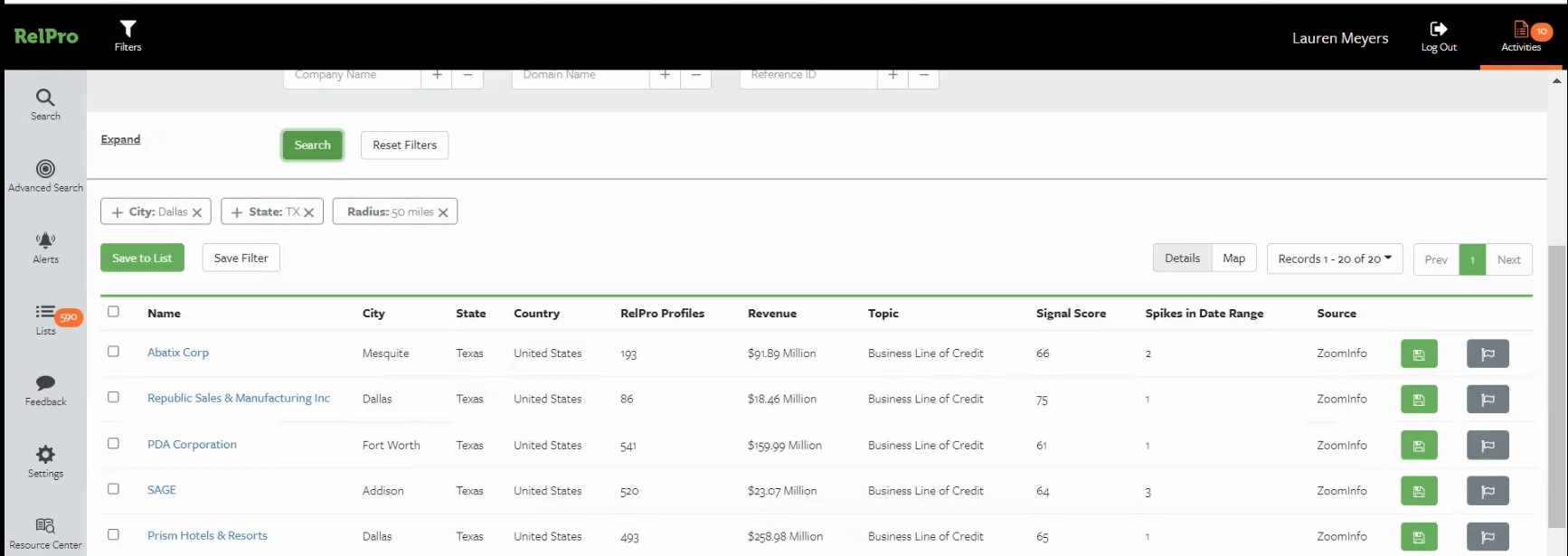
The intent data, sourced from Zoominfo, contains 66 signals related to financial research and products.  RelPro has removed the noise from thousands of non-relevant topics by limiting the topics to standard commercial banking services.

Intent Data search results include signal score and spikes across a date range.

Users may screen against the intent topics, spike period (last week to past three months), audience strength, signal score, minimum spikes in the date range, and standard firmographics.  Audience strength and minimum spikes ensure that the research is broadly based and sustained, avoiding spurious spikes created by a single employee doing heavy research on a topic for a day or two.

Audience strength is an intent distribution score containing the volume of searches on a topic across a company’s IP addresses.  Other variables include the number of IPs at a company, the number of days investigating a topic of interest, how many times they viewed the page, and company size.

The minimum score lets banking professionals dial up or down the precision.  Intent data falls along a bell curve, with sixty being a twenty percent increase in topical activity.  Sixty, the lowest signal score for screening and presentation, is a relatively low threshold, particularly if the search is being performed across multiple weeks or months.

An intent tab lets Relationship Managers view an account’s spiking topics and each topic’s signal score, audience strength, and spikes in date range, helping them determine which financial products may be of interest to the account.  If there are multiple signal spikes over a date range, the signal score is the average of the spike scores.

The RelPro company Intent Tab details spiking topics, audience strength, frequency of spikes, and the last signal date.

A last signal date indicates the last time the topic spiked, while the spikes in date range indicate the frequency of spikes over the date range.  These fields help determine the recency and frequency of interest, particularly if low signal thresholds or a long search period have been selected.

RelPro added eight million CRE loans to its platform, helping financial services companies target companies and assess risk.  Mortgage fields include property type, lender, loan amount, assessed value, execution, and maturity dates.

CRE Title Records in a RelPro company profile.

Users can view mortgage data and screen against it in Build-a-List.  Along with CRE data, RelPro provides UCC (US liens), PPP and PPS loans (pandemic), and 7A and 504 (Small Business Administration) loans.

RelPro did not disclose the source of its CRE mortgage data.

RelPro claims that 50% of the top US banks license its service.

RelPro Loan and Lien Screening variables.

ZoomInfo Acquires Dogpatch Advisors

On its earnings call last week, ZoomInfo announced a pair of acquisitions that closed on April 1: Comparably (discussed yesterday) and Dogpatch Advisors.

Dogpatch Advisors is a “modern sales advisory consultancy that helps enterprises scale revenue operations, build sales playbooks, use data and insights to create and refine sales, and build outbound operations functions.”  In addition, Dogpatch will “enable ZoomInfo to further drive Enterprise and Strategic revenue through expanded customer playbooks that utilize more data and product categories.” 

Dogpatch was immediately rebranded as ZoomInfo Labs, providing a “new go-to-market thought leadership team” that “drives go-to-market data analysis, product enhancements, and strategy for our enterprise customers.”

Dogpatch CEO Ben Salzman will be heading up ZoomInfo Labs.

“This will immediately expand our capabilities for enterprises and drive enhancements across our suite of products,” stated Schuck.  “Over time, we expect ZoomInfo Labs to put the modern go-to-market playbook within reach of every company.”

“Dogpatch Advisors is professional services and consultancy firm that helps enterprises build out their go-to-market efforts using data and insights and software to make those go-to-market efforts incredibly effective and efficient.  And when we talk with our customers and our prospects…they want a world where their go-to-market motions are driven by data, where our software is interconnected seamlessly, where they have the ability to run innovative sales playbooks, but they don’t have a pathway to get there.

What we’re hoping to do with ZoomInfo Labs is to provide a mechanism to help our customers see a future that’s innovative, that’s data-driven, where systems are integrated and talk to each other, where our data cloud sits at the foundation of that, and our application layer drives the interconnectivity of that motion… [ZoomInfo Labs] is designed to help our customers not only see that vision but then also achieve that.”

ZoomInfo CFO Cameron Hyzer

Both acquisitions closed on April 1 but were announced on May 2.  Individual deal terms were not disclosed, but the two firms were acquired for “approximately $145 million, inclusive of the purchase of a convertible promissory note and cash, net of cash acquired, subject to adjustments for working capital, transaction-related equity awards, and other customary adjustments.”

ZoomInfo also agreed to pay up to $28 million in equity awards “subject to continued employment and/or attainment of certain financial metrics.”

“We expect these acquisitions to contribute revenue in the low teens millions of dollars in 2022 and create a modest drag on margins of one to two points for the remaining quarters this year,” said Hyzer.

CEO Cameron Hyzer said that Dogpatch was more than an acquihire deal.  While it has a small employee base, Dogpatch has “relationships and a history of really delivering great go-to-market consulting engagements for large clients.”

“It’s a handful of people, but I think that they very much box outside of [its weight] class in terms of the value they’re able to deliver,” continued Hyzer.  “And we think that by bringing that on and being able to deliver those engagements that we’ll be able to further accelerate the solutions that we’re offering as well.”

ZoomInfo Acquires Comparably

At its earnings call last week, ZoomInfo announced a pair of acquisitions: Comparably and Dogpatch Advisors (rebranded as ZoomInfo Labs). Comparably builds out ZoomInfo’s capabilities and content in the recruitment space while Dogpatch provides ZoomInfo with professional services capabilities around data deployment and playbook development.

Comparably is a SaaS provider of employer branding, recruitment marketing, and an employee review platform.  Comparably surveys and collects culture insights and compensation data directly from verified employees.  It also publishes the “Best Places to Work Awards.”  Comparably serves “a large portion” of the Fortune 500 and had over 20 million global visitors last year.  Comparably helps syndicate awards across major business and news outlets.

“ZoomInfo’s acquisition of Comparably represents a pitch-perfect response to these changes,” blogged Senior Content Manager Sailee Sarangdhar.  “Comparably, a leading employee review website and the only platform showcasing workplace culture, salary, and corporate brand reputation data, attracts more than 3 million people per month who rely on its comprehensive data about companies of all sizes.  Comparably, combined with ZoomInfo’s already formidable data and software tools, gives talent leaders and companies of all sizes more powerful ways to activate their employer brand, helping to better influence prospects and convert candidates in their pipeline.”

Comparably assists with a company’s career site, Google Search placement, featured articles, media and press, social content, and video testimonials, helping amplify employee sentiment to promote the company and its culture.

“Millions of visitors come to our website to better understand company cultures, access salary data, and get employee insights.  We’ve also built a popular set of software solutions to help companies enhance their employer brand and recruitment marketing,” explained Comparably CEO Jason Nazar.

Comparably recognizes that candidates prefer to work for firms with strong leadership and healthy cultures aligned with their values.

“Simply reaching out to these candidates is no longer enough — to succeed, employers need to showcase why their workplace is one that job seekers would be proud to join,” explained Sarangdhar.

The Comparably acquisition augments RecruitingOS, which the firm is rebranding as TalentOS, and positions it as “a superior talent platform that enriches the talent search experience for recruiters.”  Recruiters will also benefit from enhanced talent data fed into ZoomInfo’s “Likely to Listen” score.

Employer branded content will be integrated into ZoomInfo Engage, “enabling recruiters to leverage statistics, awards, testimonials, videos, and more in their talent sourcing efforts.”

Finally, Insights from Comparably will be deployed to ZoomInfo MarketingOS for executing targeted ad campaigns for specific roles.  Sarangdhar argues that “combining the power of awareness-generating ads with website visitor insights has the potential to be a game-changer for HR and recruitment teams.”

“Job seekers are more educated and discerning than ever before, and companies are going to unseen lengths to recruit candidates of all backgrounds and skillsets,” said Nazar.  “Comparably has distinguished our brand as a unique data asset reflecting fair and accurate company cultures and the most popular SaaS platform for employer branding and recruitment marketing solutions.  Partnering with ZoomInfo is an incredible opportunity to continue to support millions of employees and thousands of businesses and to help revolutionize how the modern challenges of recruiting are solved.”

TalentOS, which was launched in June 2021, has been deployed by over 1,000 companies.  Product customer counts and ACV grew 50% quarter-over-quarter in Q1.

New user functionality includes a guided onboarding journey and a new experience for launching initial email automation campaigns.  In addition, power users can leverage an advanced Boolean search capability and a redesigned AI-powered similar companies recommendation engine for recruiting.

“With Comparably, TalentOS gives companies the ability to engage and hire candidates with much more sophistication and influence,” stated CEO Henry Schuck.  TalentOS plus Comparably is a must-have combination for any company recruiting in today’s competitive work environment.  As an enterprise go-to-market, we know that the best-performing enterprise companies are leveraging data, insights, and software for their revenue operations, and they are significantly outperforming go-to-market teams early on in their digitization journey.  Access to high-quality, relevant data provides significant competitive advantages for all sales and marketing organizations.”


Continue to the Dogpatch Advisors acquisition (ZoomInfo Labs) blog…

Chorus Mobile App

Chorus, which was acquired by ZoomInfo last summer, rolled out a mobile app for its conversational sales service.  The app supports core Chorus features on Android and iOS phones.  Users can listen to calls, speed them up, and pause them.  They can also share key moments with colleagues via Slack, email, and text.  Hashtags and @ mentions assist with tagging and sharing.

Managers and trainers can assign listening and provide feedback, which can be reviewed during walks, commutes, or downtime.  Users also have access to a library of best practices spanning various topics, including objection handling, pitching to specific verticals, or value discussions.

“With Chorus, reps can review top performers’ recordings on their own schedule,” said Alyson Baber, commercial sales leader at Zoom.  “They can also focus on keywords, such as a competitor’s name or pricing information, and go directly to those parts of the discussion instead of having to sit through the entire call.”

Customer Success and Account Teams can review preceding conversations, review conversations before quarterly business reviews, and share the voice of the customer or product feedback with other teams.

Chorus has over 20,000 customers.

Chorus iPhone screenshots

ZoomInfo Elaborates on MarketingOS during Earnings Call

ZoomInfo continued its rapid growth, posting GAAP revenue of $222.3 million, up 59% year-over-year.  Growth was both organic (52%) and via acquisitions (7%), with a net retention rate of 116%, up from 108% in 2020.  Revenue grew 13% on a sequential basis.

Roughly half the increase in net retention was due to new functionality, and half was due to improvements in gross retention and lower down-sell rates associated with the initial shock of COVID in 2020.

High-level MarketingOS functionality (Source: ZoomInfo briefing)

CEO Henry Schuck is bullish about their new MarketingOS offering as part of RevOS.  Since acquiring Clickagy 16 months ago, the firm has been building out ABM expertise in its engineering, product, strategy, and customer success teams to bring the new marketing suite to market.

“In all of our prelaunch diligence, we heard over and over again that the applications that marketers were leveraging to do account-based marketing were falling short for one main reason,” detailed Schuck.  “The data being leveraged in those platforms was both inaccurate and incomplete.  And that’s no surprise.  Today’s ABM platforms were all designed to leverage a company’s own first-party data that exists in their CRM or marketing automation system.”

“And in 15 years of running ZoomInfo, I’ve never heard a rep manager or revenue leader describe that type of data as either complete or accurate.  Yet without accurate and complete data, marketers aim advertising dollars at the wrong company and target the wrong people at those companies.  They deliver fruitless leads to sales, which erodes confidence and fails to build alignment between sales and marketing.  So, we built MarketingOS the same way we build every application with our best-in-class data at the foundation of the application layer…

For today’s B2B revenue teams, data, insights, technology, and orchestration are core to the motion they use to market and sell their products.  But these capabilities are siloed.  Some can be found in marketing tech or revenue operations, while others are in the sales tech stack.”

ZoomInfo CEO Henry Schuck

MarketingOS also benefits from ZoomInfo’s longstanding presence among sales teams, improving the credibility of marketing data and removing channel conflict induced by sales and marketing standardizing on different third-party reference databases.

According to Schuck, the RevOS positioning helps reps better explain ZoomInfo’s broad value proposition:

“What RevOS does for us, and what the different platform and product pillars do for us, is it gives us a cohesive story that we can tell all across our business from our enterprise business to our mid-market business to our SMB business. And we believe that the products that we’ve put together have applicability across customers of all sizes…What it does from an enablement perspective is it gives our sellers the ability to go into those conversations in a way that allows them to articulate the broad spectrum of the platform in a way that our customers are understanding much more clearly.”

ZoomInfo CEO Henry Schuck

It test-marketed the RevOS positioning in December and January and found that the updated messaging raised both the win rate and average sales price.  RevOS messaging helps reps position Chorus, RingLead, and Engage at the beginning of conversations.

ZoomInfo now presents itself as a best-of-breed platform that replaces disparate elements of the sales and marketing tech stacks.

ZoomInfo, which announced the RevOS ABM Platform last week, is positioning itself as a best-of-breed platform for revenue teams.  ZoomInfo offers a unified platform for sales and marketing, removing the need to stitch together many point solutions that address individual workflows or problems.  With over 10,000 MarTech solutions alone (according to Scott Brinker of ChiefMartec), selecting and integrating many services has become increasingly difficult.  Conversely, go-to-market platforms such as ZoomInfo ABM Platform manage data, workflow, analytics, forecasting, and communications.

ZoomInfo is not looking to displace systems of record such as CRMs or MAPs but to synchronize with them and enrich their data.  For the past few years, it has been growing beyond traditional sales intelligence (companies, contacts, technographics, event triggers) to workflow, data orchestration, and engagement tools (webforms, visitor intelligence, programmatic marketing, chat, triggered workflows, sales cadences, engagement analytics, conversational intelligence, pipeline forecasting, etc.).  In 2021 it shifted from content acquisitions (e.g., Zoom Information contacts, Clickagy intent, Everstring business graphs) to orchestration (e.g., RingLead) and Engagement (e.g., Insent chat and Chorus Conversational Intelligence and forecasting) acquisitions. 

Likewise, ZoomInfo’s expanded product offerings support Sales Engagement, Recruitment, and ABM.

“We significantly expanded our offering by developing an application layer on top of our best-in-class data assets and acquiring and quickly integrating chat conversation intelligence and orchestration technology into the platform,” explained Schuck.  “These innovations enabled us to add more new customers than ever before and drove increasing levels of sales to existing customers and record net revenue retention of 116%, up from 108% in 2020.”

From a GTM perspective, ZoomInfo is not looking to verticalize its platform but focus more on functional specialization.  As a result, the new RevOS platform positioning focuses on four functions: Marketing, Sales, Operations, and Recruitment.

“It’s more aligned around personas that we sell to,” explained Schuck.  “The new packaging and models that we’re rolling out are aligned around persona, so a sales persona, a marketing persona, an operations persona, and a recruiter and talent acquisition persona.  And that’s the way we really think about our offering and the way that we take them to market.”